Problem
Colorectal cancer is a leading cause of cancer death
new cases a year worldwide
deaths a year worldwide
of patients are alive five years after the cancer has spread
Sources: WHO colorectal cancer fact sheet / GLOBOCAN 2022 (cases and deaths); American Cancer Society and SEER (distant-stage five-year survival: 13% colon, 18% rectum).
Target
CEACAM5 is found on colorectal cancer cells and has clinical precedent
On the tumour
CEACAM5 is highly expressed in colorectal cancer, with limited expression in normal tissue.
| Binder | How it worked |
|---|---|
| CEA-Scan (99mTc-arcitumomab) | Approved in Europe in 1996 to find recurrent colorectal cancer |
| 131I-labetuzumab | Reached tumours; median survival of 55 months in a 63-patient phase II study |
| 90Y-DOTA-M5A | Reached tumours; 10 of 16 patients had stable disease |
Antibody-based agents reach the tumour but are held back by blood and marrow toxicity.
Sources: He et al., Eur J Nucl Med Mol Imaging 2023 (expression); NCI and EMA (CEA-Scan); Sahlmann et al., Cancer 2017; Akhavan et al., 2020. Small studies, not proof of benefit. Our binders have not been tested in a lab.
Our approach
AI designs a small protein that carries radiation to colorectal cancer cells
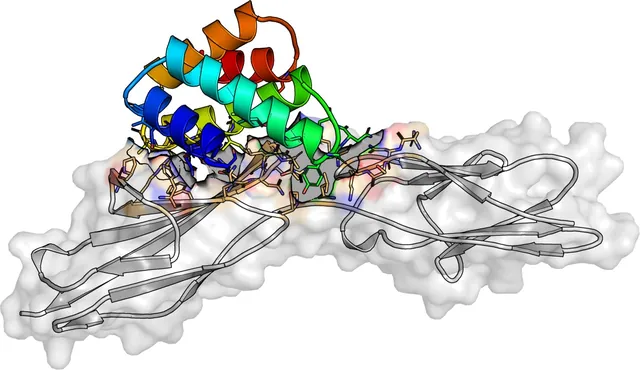
AI designs it
A small protein, made to attach to CEACAM5.
It finds the cancer
CEACAM5 sits on colorectal cancer cells.
It delivers radiation
A radioactive atom on the protein treats the tumour.
The linker, radioactive atom, kidney clearance and tumour retention are experimental requirements and have not been tested. The aim of a small protein is to clear the blood faster than antibodies; this is to be tested in the lab.
Progress
Several promising candidates, and a pipeline to find more
Candidates
Several designs look promising. Lab testing is the next step.
Pipeline
A repeatable AI pipeline that designs, scores and re-checks new binders against CEACAM5, so we can keep generating candidates.
Current stage: our work so far is computational. Our binders have not been tested in a lab.
Team
A software developer and a peptide-chemistry pharmacist
Mitchell Benjamin
Melbourne
Software developer specialising in AI and machine learning.

Elsa Welin
Sweden
Pharmacist specialising in peptide chemistry. MSc Pharmacy, Uppsala University; BSc, Lund University.